Teachers from Mexico and California collaborate to teach algebra
 By Sarah Tully, EdSource
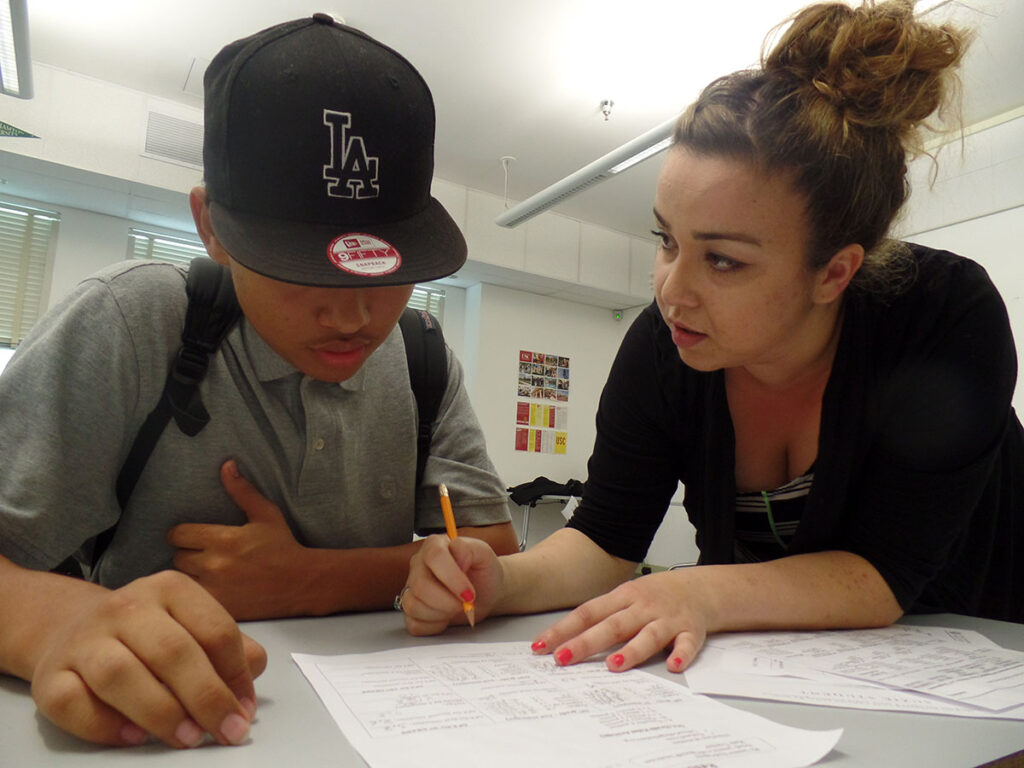
Teacher Edith Issakhanian, left, helps student Oscar Navarrete, 16, with a math trouble in a summertime schoolhouse grade at West Adams Preparatory Academy in Los Angeles on July 17.
 By Sarah Tully, EdSource
Teacher Edith Issakhanian, left, helps pupil Oscar Navarrete, 16, with a math problem in a summer school form at West Adams Preparatory University in Los Angeles on July 17.
A group of Los Angeles students who are new to the United States spent part of their summertime pause learning algebra in a pilot program with materials that are lacking in virtually places nationwide – Common Cadre-aligned lessons in Spanish.
For 5 weeks, high school students completed an algebra class given in both English language and Spanish past teachers from the Los Angeles Unified Schoolhouse Commune and the Academy of Guadalajara in Mexico. All of the Los Angeles Unified students in the class take lived in the United states for less than a year, speak Castilian equally their native language and take minimal English language skills. In the end, 36 students completed the grade in July.
The class used a new online curriculum that toggles between English language and Castilian, adult by Academy of California and Guadalajara university educators in the hope that eventually some schools in both countries may use the materials.
"I don't think there'due south much question that there's a real need out there for this support," said Patrick Callahan, statewide co-director of the California Mathematics Project, who helped develop the curriculum. "I think the challenge is that it's non just an upshot of translating into Spanish, but a combination of understanding the more rigorous expectations of the Mutual Core and how that plays out for English language learners."
This fall, Los Angeles Unified officials will decide how the materials could be used in classrooms, said Gerardo Loera, the district's chief academic officer. The goal is that the curriculum will be a central part of some algebra classes and may eventually be extended to all newcomers in the district.
"We see it as a promising project for us," Loera said.
While UCLA has directed a project to aid Spanish-speaking high schoolhouse students since 2008, this new class for the outset fourth dimension is aligned with Mutual Core standards, said Patricia Gandara, co-director of the UCLA Ceremonious Rights Project, who leads Project SOL, or Secondary Online Learning. Project SOL has worked with educators in Mexico since the beginning, just it is i of the few programs of its kind to incorporate schooling from both sides of the border.
Proposition 227, the 1998 state constabulary that banned bilingual instruction, generally forbids Castilian-language education and materials in nearly cases, unless there is a waiver. Only the restrictions only apply for those students under age 10, Gandara said.
Projection officials chose to focus outset on algebra considering it is considered a gateway for higher-level classes and college preparation, Gandara said. In addition, the need for language help is greater in math, since English learners tend to get more help in other subjects. Next twelvemonth, Gandara hopes to add geometry and algebra Ii.
Gabriela Uro, manager of English language learner policy and inquiry for the Quango of the Slap-up City Schools, said schools nationwide are struggling to find native-language materials to assist students. She said programs similar Los Angeles Unified'south – which use online curriculum and teachers from the U.S. and Mexico – are rare. She knows of just ane other in Yakima, Launder., in which U.Southward. students use online curriculum from Mexico.
"It was a challenge even earlier Common Core. Now with Common Cadre, the publishers are focused on revising (books) in English," Uro said. "Producing them in Spanish doesn't come up as a large priority."
It'southward especially an issue in Los Angeles Unified, which has the largest population of English language learners in the country – nigh 164,349 in 2014-xv, according to state data.
Statewide, about i.iv one thousand thousand students are English learners. The vast bulk – 84 per centum – speak Spanish.
Still, Los Angeles Unified doesn't have "a huge library of primary language materials," Loera said.

Sarah Tully, EdSource
Teacher Jazmin Rodriguez, left, gives a loftier five to student Javier Garcia, 15, while teacher Manuel Rosas Verdin from the University of Guadalajara looks on, July 17, 2015. The two teachers co-taught an algebra course in Los Angeles Unified School District.
Loera said information technology'southward difficult for teachers to determine if students don't know a field of study – like how to solve algebra equations – or whether they don't understand the vocabulary. Native language materials assist explicate the bailiwick matter while students are still learning the English language words.
The summer class was held at the district's West Adams Preparatory High School, just west of downtown Los Angeles, that has seen an influx of new immigrants in contempo years, said Assistant Main Jose Gonzalez. Many of them are from Central America, including some considered "unaccompanied minors" who had spent time in immigration detention centers before entering Los Angeles schools.
Overall, about 27 percent of the schoolhouse'due south students are English learners, co-ordinate to country data. The commune doesn't runway numbers of students who are new to the country, Loera said.
Everyone in the summer school course had failed algebra during the school year. The summer class was aimed at students with beginning-level English skills – the first fourth dimension a makeup class was offered for that group.
Although the students were all enrolled in algebra during the school year, their math abilities varied. Some had been attending school in United mexican states or Key America before moving to the U.s.a., while others hadn't been in classes recently.
Some students needed help with the basics, such as fractions and multiplication, said Edith Issakhanian, one of two Los Angeles Unified teachers in the pilot. Others seemed to sympathize algebra, although they struggled with the vocabulary.
As part of the summertime school class, students answered math discussion problems on iPads, going back and forth between English and Castilian, so they could main the vocabulary and explicate the concepts.
"I think that those kids were a little skeptical at the beginning," Gonzalez said. "They were non sure what was happening or what to wait. As the programme continued, they realized they were being taught in the main linguistic communication. It made it a lot easier."
Omar Contreras, 18, who is going into 10th grade, started at West Adams in February. He had left school at historic period 14 to work in the fields, growing corn and beans, in Republic of el salvador. Students like Contreras, who missed some years of schoolhouse, can stay in traditional high schools past their 18th birthday if they are making academic progress, Gonzalez said.
In class during the school twelvemonth, Contreras said a Castilian-speaking aide sometimes explained material. But the summer school grade helped more than because of the Spanish translations on the iPad, Spanish-speaking teachers from United mexican states and group work with students of like backgrounds. He got a B.
"They explain it improve," Contreras said in Spanish about the summer school class.
Alfonso Benitez, 17, an incoming 10th-grader, was born in Los Angeles, but he moved to Guadalajara, Mexico, at age 2. Later on returning to Los Angeles, he enrolled in school in Jan and initially struggled with algebra because he had never taken the subject earlier.
"I understood the (summer) class very well because information technology was bilingual," Benitez said in Castilian.
Previously, Project SOL offered higher-prep math and science classes to about 500 Castilian-speaking immigrant students in four Southern California high schools from 2008 to 2012. While the plan increased admission to those classes, less than half got a C or better in those classes, according to the projection.
In 2013, the project launched its "2.0" version to build on that program, making it aligned both to the Common Cadre in the Us and school standards in Mexico. Somewhen, the goal is for students to get form credit in both countries, peculiarly for those who go back and forth, Gandara said.
Compared to the previous California standards, Mutual Core-aligned math is considered more difficult for English learners. Before, students were assigned more numeric computations, like two + ii, which are the same in both languages. But students now demand to explain or write out how they came upwardly with answers.
Issakhanian, the summer school teacher, said she used some of the early on Spanish materials from Project SOL during the school year to help students in her classes who didn't sympathise English. Because she didn't take technology, she printed out papers, which her students appreciated. Other than that, Issakhanian had to rely on other Spanish-speaking students to translate the material that they might non understand themselves.
"I really am excited about this programme and I hope a lot of schools take it on," Issakhanian said. "For me as a instructor, it makes me happy to have the materials to go far an fifty-fifty ameliorate experience for my students."
To get more than reports like this one, click here to sign upward for EdSource's no-cost daily email on latest developments in instruction.
Source: https://edsource.org/2015/spanish-language-materials-help-new-immigrants-with-algebra/83869
0 Response to "Teachers from Mexico and California collaborate to teach algebra"
Postar um comentário